
Bioavailability
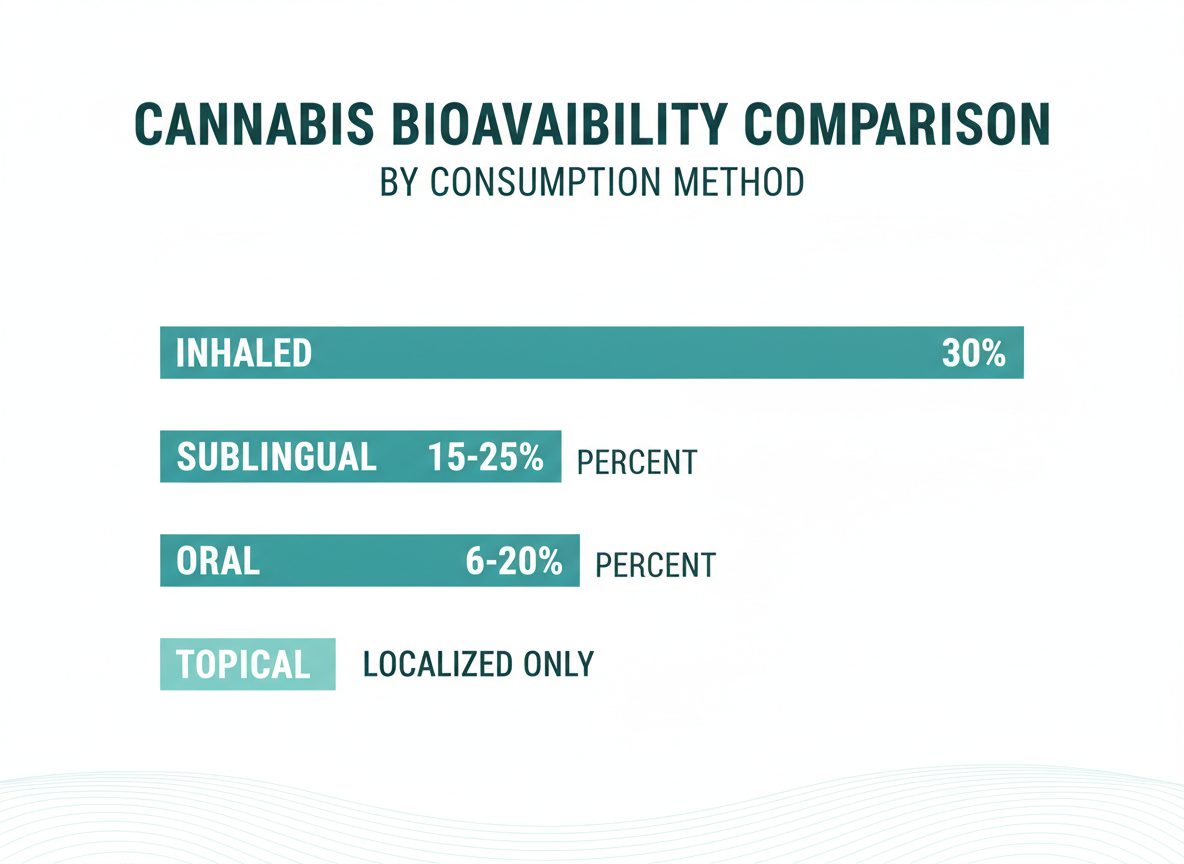
Bioavailability (F) is the fraction of an administered dose reaching systemic circulation unchanged, determining how much cannabinoid is available to act at CNS targets. Inhalation: 10–35% for THC, highly variable with device, puff topography, breath-hold, and experience (Huestis 2007 Chem Biodivers; Grotenhermen 2003). Oral: 4–12% for THC — low because of poor aqueous solubility, incomplete absorption, and extensive hepatic first-pass metabolism (Ohlsson et al. 1980; Grotenhermen 2003). Sublingual/oromucosal: 6–15%, partially bypassing first-pass (MacCallum & Russo 2018). Transdermal: very low and variable for THC (poor skin permeability of lipophilic parent); CBD shows better transdermal flux. Lipid-based edibles and nanoemulsion formulations can raise oral F several-fold. High variability between individuals means the same labeled dose produces very different systemic exposures. Cross-reference First-pass metabolism, Dose. Citations: Huestis MA. Chem Biodivers. 2007;4:1770-1804; Grotenhermen F. Clin Pharmacokinet. 2003;42:327-360; MacCallum CA, Russo EB. Eur J Intern Med. 2018;49:12-19.