
Endocannabinoid system (ECS)
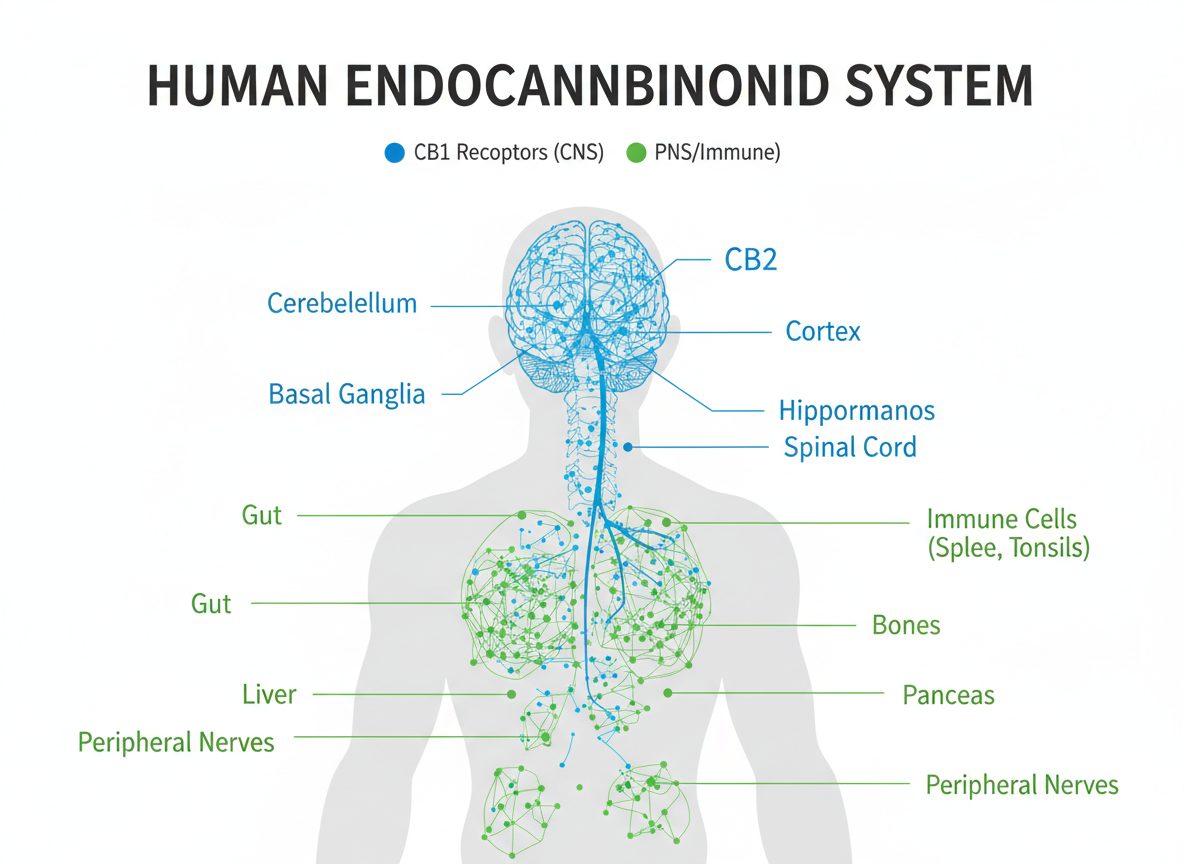
The endocannabinoid system (ECS) is a widely distributed lipid-based signaling network comprising (1) the G protein-coupled cannabinoid receptors CB1 and CB2, (2) the endogenous lipid ligands anandamide and 2-arachidonoylglycerol, (3) the biosynthetic enzymes (NAPE-PLD for AEA; DAGLα/β for 2-AG), and (4) the degradative enzymes FAAH and MAGL. It was discovered piecewise: CB1 cloned by Matsuda et al. (1990, Nature 346:561), anandamide identified by Devane et al. (1992, Science 258:1946), CB2 cloned by Munro et al. (1993, Nature 365:61), and 2-AG identified by Mechoulam et al. (1995) and Sugiura et al. (1995). The ECS modulates pain, appetite, mood, memory, immune function, reproduction, neuroprotection, and energy metabolism and is broadly understood as a homeostatic "buffer" system (Di Marzo, 2018, Nature Reviews Drug Discovery 17:623). → See also: CB1 receptor, CB2 receptor, Anandamide, 2-AG, Homeostasis.