
Trichome
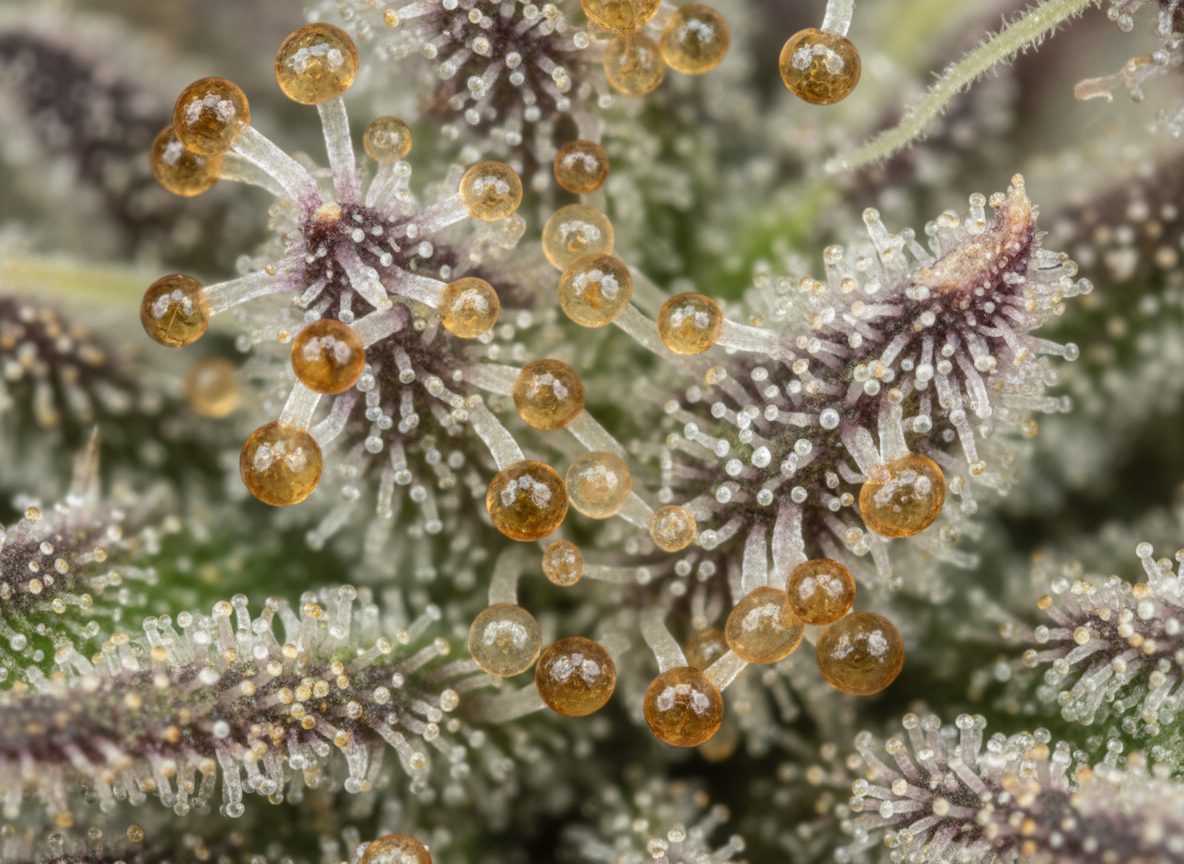
Trichomes (Greek trichōma, "growth of hair," from thrix/trichos, "hair") are unicellular or multicellular epidermal outgrowths. In Cannabis sativa they are the principal site of cannabinoid, terpene, and flavonoid biosynthesis and storage, accumulated densely on perigonal bracts and sugar leaves of unfertilized female inflorescences (Hammond & Mahlberg 1973; Livingston et al. 2020; Tanney et al. 2021). Cannabis trichomes fall into two broad classes. Glandular (secretory) trichomes comprise three recognized morphs: capitate-stalked, with a multicellular stalk bearing a large secretory head of 12–16 disc cells and the principal producers of cannabinoids and monoterpene-dominant terpenes (Livingston et al. 2020); capitate-sessile, with a short or absent stalk and typically 8 disc cells, producing more sesquiterpene-rich profiles — Livingston et al. (2020) showed many "sessile-appearing" trichomes on immature flowers are developmental precursors of stalked forms; and bulbous, the smallest at ~15–30 μm, with limited metabolic output. Non-glandular trichomes include unicellular cystolithic trichomes (hook-shaped with a basal CaCO₃ cystolith, on adaxial leaf surfaces) and non-glandular covering trichomes (slender, pointed), which provide mechanical and UV defense rather than metabolite secretion (Hammond & Mahlberg 1973; Tanney et al. 2021). Maturity is assessed visually by head coloration — clear → milky/cloudy → amber — correlating loosely with THCA → CBNA conversion and peak monoterpene volatilization (Livingston et al. 2020). Synonyms/slang: resin glands, crystals, "frost," "sugar," kief (when detached). → See also: Resin, THC, CBD, Terpenes (Chemistry), Kief (Products), Bud, Sugar leaf.