Flowering
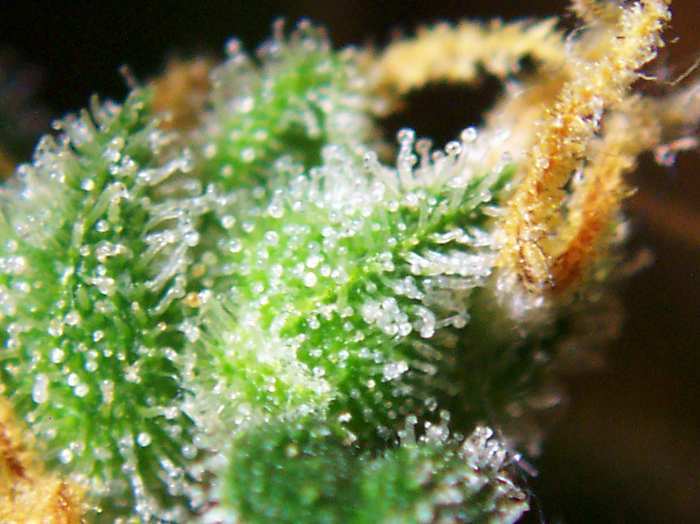
Flowering is the reproductive phase in which cannabis shoot apical meristems transition to floral meristems, producing compound racemose inflorescences composed of repeating phytomers — reduced leaves, bracts, perigonal bracts, and solitary flowers — with up to seven orders of lateral branching (Spitzer-Rimon et al. 2019). Indoor cultivation triggers flowering by abruptly reducing the photoperiod from ≥16 h to 12 h (Potter 2014; Zhang et al. 2021). Growers recognize four stages: (1) pre-flower / transition, with appearance of ≥3 pairs of stigmas at the shoot apex; (2) stretch, 1–3 weeks of rapid internode elongation that often doubles plant height; (3) bud formation / filling, with rapid perigonal-bract, trichome, and cannabinoid accumulation; and (4) ripening / maturation, when stigmas senesce from white to orange-brown and trichome heads shift from clear to cloudy to amber (Livingston et al. 2020; Spitzer-Rimon et al. 2019). Total duration is cultivar-dependent (6–14 weeks). Etymology: Old English flōr (related to Latin flos/floris, "flower"). Synonyms: bloom, "flip" (transition), reproductive phase, generative phase. → See also: Photoperiod, Bud, Cola, Trichome, Pistil.