Topping
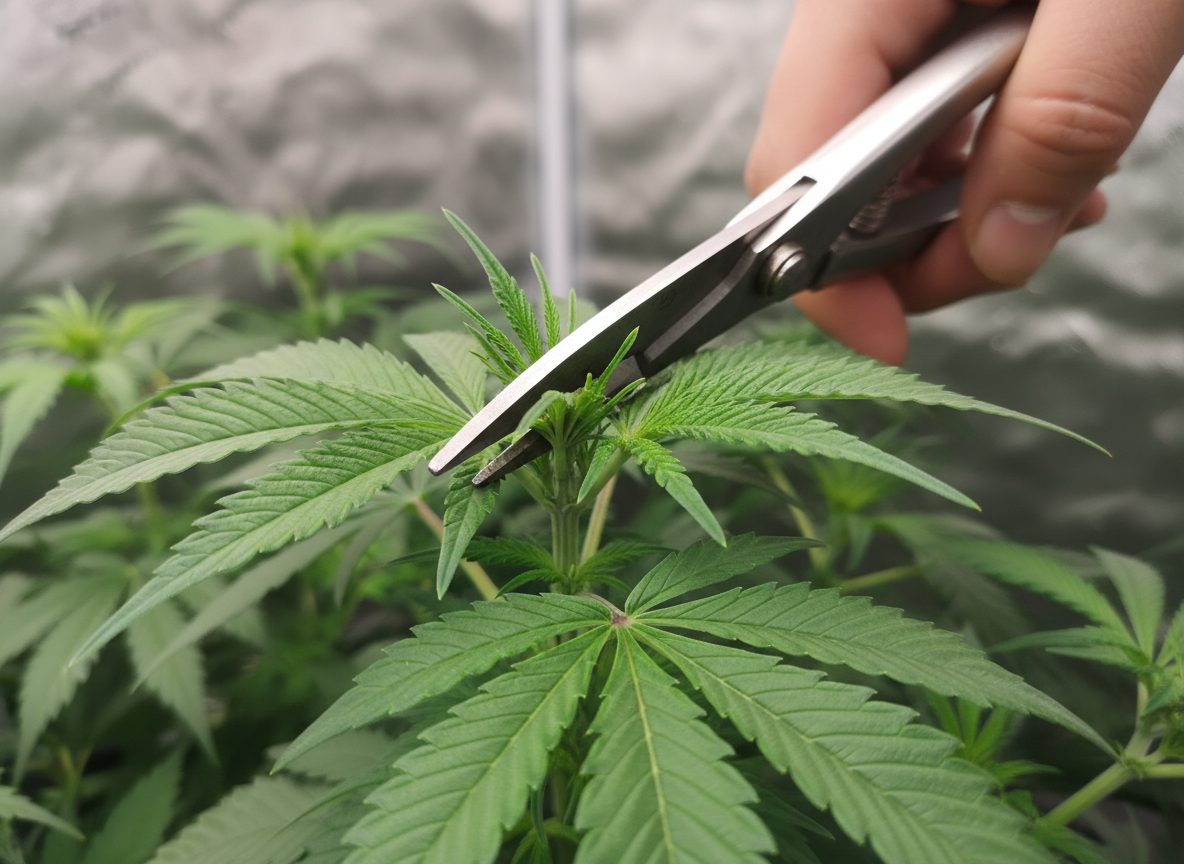
Topping is a high-stress training technique in which the apical meristem of the main stem is severed, typically above the 4th–6th node, abolishing apical dominance and redistributing auxin so that the two sub-apical axillary meristems develop into co-dominant shoots. The practice converts monopodial "Christmas-tree" architecture into a multi-cola, bushier canopy better suited to uniform horizontal light distribution indoors. Danziger & Bernstein (2021, Industrial Crops and Products 167:113528, "Plant architecture manipulation increases cannabinoid standardization in 'drug-type' medical cannabis") showed that "single prune" and "double prune" treatments elevated cannabinoid concentrations in lower inflorescences and improved whole-plant chemical uniformity relative to untrained controls. Topping is generally performed during vegetative growth to allow 7–14 days of recovery before photoperiod shift; repeated topping (main-lining, manifolding) produces geometrically symmetrical canopies with 4, 8, or 16 primary colas. Etymology: Old English topp, "summit," + gerundive suffix. Synonyms/slang: pinching, tipping, decapitation. → See also: FIMing, Pruning, HST, Cola.