
Kief box
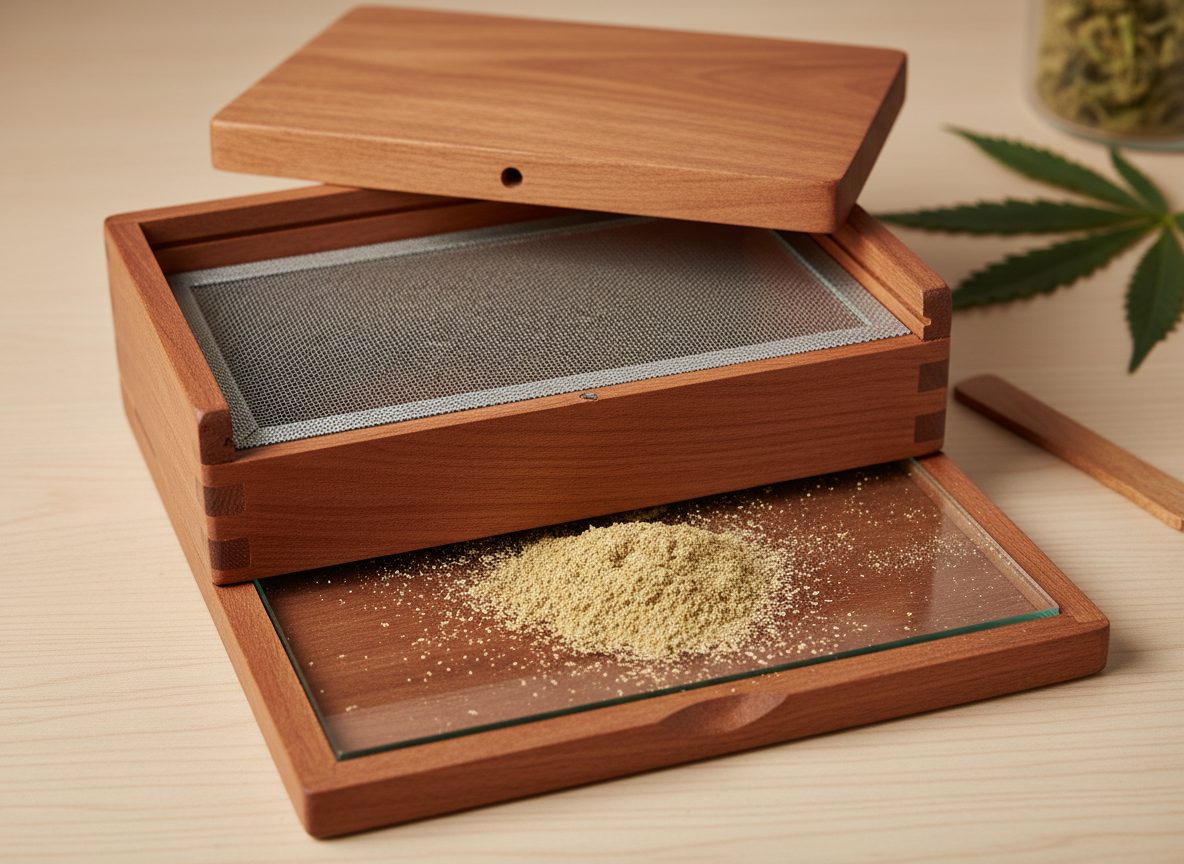
A kief box is a wooden or composite enclosure fitted with one or more micron-rated mesh screens used to mechanically separate trichome heads from dried flower via gentle agitation. The standard design is three-chambered: a top chamber serving as lid and work surface (often doubling as a rolling tray), a middle chamber holding the screen or screens, and a bottom chamber — usually a tempered glass mirror — collecting the sifted trichome material. Screen specifications vary by tier. Single-screen consumer boxes use meshes in the 100–150 µm range. Multi-screen artisan boxes use descending micron sizes (for example, 180/120/75 µm) for one-pass graded separation. The mechanical principle is straightforward: trichome heads measure roughly 50–150 µm in diameter and are approximately spherical; when dry flower is agitated over a screen, brittle trichome stalks fracture and the smaller heads fall through the mesh while larger plant particulate is retained above. Construction materials commonly include pine, bamboo, walnut, and Baltic birch; screen media use nylon, silk, or stainless steel; and neodymium magnetic closures are standard on higher-end boxes. Synonyms include pollen box, pollen sifter box, sifter box, shaker box, kief sifter, kief catcher, and dry sift box. David of Oregon Rootz is credited with designing the first purpose-built kief box in 1998. → See also: Kief, Dry sift, Pollen, Screen